Sebastian, Penetration
2025, Dried bacterial cellulose, vintage arrows, scrap metals, artificial sinew, drywall
36 x 28 x 54 in
Arrows fan outward from a dark, curled mass pinned to the wall. Cazares uses dried bacterial cellulose, a material grown by bacteria, as a substitute for flesh. The arrows recall the martyrdom of Saint Sebastian: his suffering and death for his Christian faith. In many Renaissance paintings, his wounded body remains youthful and beautiful, bringing religious devotion into contact with physical attraction. His image later became important in gay and queer culture, where artists have explored its connections to desire and persecution.

Cazares gives the saint a shriveled, incomplete body, shifting attention toward its vulnerability. This raises a question about compassion: must a body be beautiful to deserve care? He brings the trans body into this discussion through his emphasis on bodily change. For Cazares, a person's worth does not depend on maintaining a fixed physical form. He finds a parallel in Christian ideas of the soul, whose value he sees as independent of outward appearance. His term post-beauty describes an outlook in which a body can be valued without first meeting an ideal of beauty. The changing body remains worthy of care, even when it departs from the forms viewers have learned to admire.
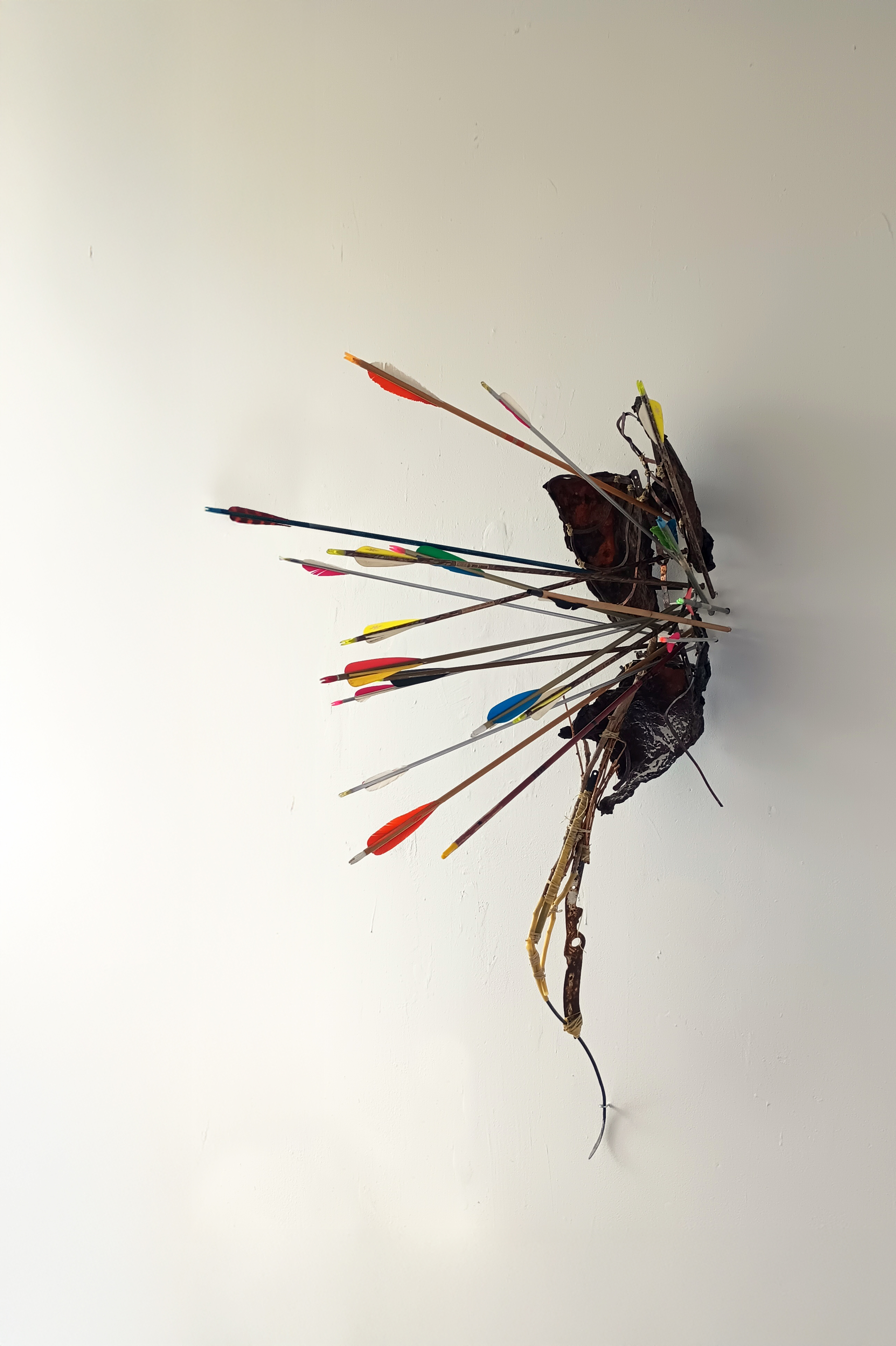
My Sebastian series of works uses bacterial cellulose cultures as a substitute for flesh, testing the limits of beauty and compassion through the martyrdom of Saint Sebastian. Here, a desiccated piece of bacterial cellulose is pinned to the wall, coiled in pain around the arrows which pierce him, those which define him.

Saint Sebastian has a long tradition of being associated with homosexuality throughout art history. Pious adoration of his eternal soul and eroticized admiration of his eternal good looks are united. But the trans body trespasses ideals of immortality and objective beauty. All flesh experiences changes throughout a lifetime, but the trans body shifts by definition - we are bodies in motion, and we remember that flesh is decoration for the soul. In this way, aspects of christianity and trans folk are united in a view of the world that is post-beauty.  
From the artist >
< From Rexhibit
Flesh   ✚
Flesh
Cazares uses dried bacterial cellulose, a material grown by bacteria, as a substitute for flesh.
Martyrdom   ✚
Martyrdom
The arrows recall the martyrdom of Saint Sebastian
Compassion   ✚
Compassion
This raises a question about compassion: must a body be beautiful to deserve care?
Trans Body   ✚
Trans Body
He brings the trans body into this discussion through his emphasis on bodily change.
Post-beauty   ✚
Post-beauty
His term post-beauty describes an outlook in which a body can be valued without first meeting an ideal of beauty.

Keyword

Statement

Image

Catalog

For the best experience, please switch to a larger screen.

We're currently optimizing this section for mobile — improved viewing will be available in future updates.

Sebastian, Penetration
Dried bacterial cellulose, vintage arrows, scrap metals, artificial sinew, drywall, 36 x 28 x 54 in, 2025
From Rexhibit
Arrows fan outward from a dark, curled mass pinned to the wall. Cazares uses dried bacterial cellulose, a material grown by bacteria, as a substitute for flesh. The arrows recall the martyrdom of Saint Sebastian: his suffering and death for his Christian faith. In many Renaissance paintings, his wounded body remains youthful and beautiful, bringing religious devotion into contact with physical attraction. His image later became important in gay and queer culture, where artists have explored its connections to desire and persecution.

Cazares gives the saint a shriveled, incomplete body, shifting attention toward its vulnerability. This raises a question about compassion: must a body be beautiful to deserve care? He brings the trans body into this discussion through his emphasis on bodily change. For Cazares, a person's worth does not depend on maintaining a fixed physical form. He finds a parallel in Christian ideas of the soul, whose value he sees as independent of outward appearance. His term post-beauty describes an outlook in which a body can be valued without first meeting an ideal of beauty. The changing body remains worthy of care, even when it departs from the forms viewers have learned to admire.

From the Artist
My Sebastian series of works uses bacterial cellulose cultures as a substitute for flesh, testing the limits of beauty and compassion through the martyrdom of Saint Sebastian. Here, a desiccated piece of bacterial cellulose is pinned to the wall, coiled in pain around the arrows which pierce him, those which define him.

Saint Sebastian has a long tradition of being associated with homosexuality throughout art history. Pious adoration of his eternal soul and eroticized admiration of his eternal good looks are united. But the trans body trespasses ideals of immortality and objective beauty. All flesh experiences changes throughout a lifetime, but the trans body shifts by definition - we are bodies in motion, and we remember that flesh is decoration for the soul. In this way, aspects of christianity and trans folk are united in a view of the world that is post-beauty.  
Contact us
Newsletter
Thank you! Your submission has been received!
Oops! Something went wrong while submitting the form.
© 2026 Rexhibit. All rights reserved.
Brooklyn, NY
Menu
Contact us
Newsletter
Thank you! Your submission has been received!
Oops! Something went wrong while submitting the form.
© 2026 Rexhibit. All rights reserved.