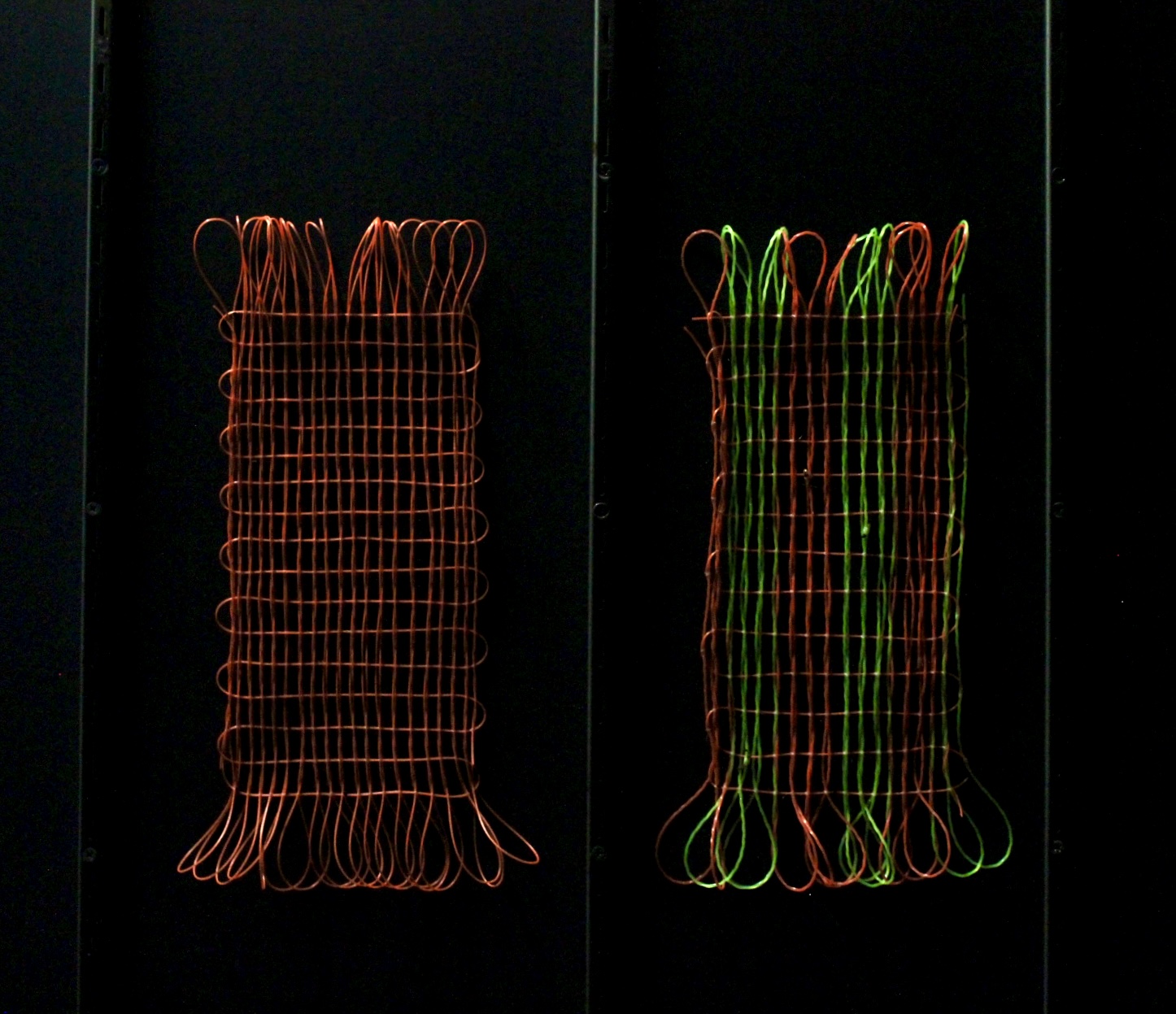
Bright weed-eater line is woven into tight grids, yet the material refuses to look fully controlled. Its loops bend outward, curl at the edges, and push against the neat rhythm of the form. Brooklin treats this line not as a passive material, but as something with its own attitude and agency. The work brings an unruly yard material into a process usually associated with repetition, order, and careful handling. Through weaving structure, Brooklin creates a space where control and resistance meet. The line follows the logic of warp and weft, but it also disrupts that logic through its stiffness, color, and physical behavior. In this way, the work questions the binary between structure and freedom, showing how a material can both enter a system and push back against it.