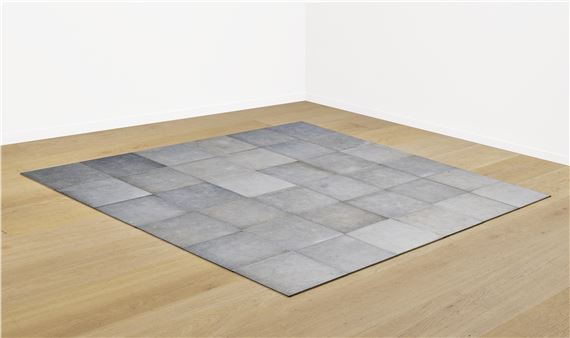
“There are no ideas hidden under those plates!”[1] quipped Carl Andre, the Minimalist sculptor known for arranging his sculptures on the ground, in reference to his own work; “They’re steel plates and nothing else!”[1] That is what might justifiably be considered a loaded statement (or a sick burn if he was referring to someone else’s work). If this pronouncement was, first, to be taken at face value, and, second, to be taken to its logical endpoint, it could reasonably be considered a disavowal of the potential for a work of art to be or express anything beyond its material form.
By saying this, Andre is making it clear that he’s already shown the viewer how the trick works. He’s saying that there’s no greater meaning hiding up his or his work’s sleeve, so the viewer shouldn’t bother looking for one. As such, according to the way of viewing art that Andre is espousing with this statement, all that you get is what you see. How, then, does one look at a work of art, abstract art, in particular, if there is nothing there except what one sees?
It is what it is: maybe not such terrible advice for looking at art?
%20by%20Charles%20Schulz%2C%20June%2021%2C%201945.%20Originally%20published%20in%201955..jpg)
First of all, let’s stipulate to a valid point: in the broadest, most literal sense, all works of art are only what they are: an assortment of materials combined by an artist in order to create an object that attempts to transcend its constituent parts. And, like a siren’s song, this material-centric point of view is a way of thinking about art that becomes more alluring as the work itself becomes more abstract.
In other words, the less representational a work of art becomes, or the less readily identifiable its subject matter becomes, so, too, the more opaque its intent and the fundamental justification for its existence becomes. Visual complexity, and its opposite, over-simplification, can both present very real barriers to a viewer’s ability and desire to engage with an artwork. It is entirely possible for an artwork to be pushed so far in either direction that a casual viewer would be forgiven for only seeing what is in front of their eyes.
In fact, some works only begrudgingly drop their veils, even for more experienced viewers. These are works that offer no easy footholds for beginning an ascent of the metaphorical mountain to the enlightenment they are assumed to contain. And, when even experienced guides seem to struggle to offer a satisfying explanation, it can begin to feel like the climb isn’t worth the effort, and everyone is making it up as they go along.
There is some truth to be found in that sentiment, though. Sometimes, some of the people assumed to know what they are doing are making it up as they go along, and that is the point. For some artists, the process becomes the aspect of the work that holds the meaning, and the outcome becomes an afterthought. There are plenty of artists who don’t know what they are going to end up with when they start a work, and not every artist intends their work to contain a deep, hidden meaning.
Sometimes an artist’s approach to the treatment of the materials is the primary purpose of the work. As with any other aspect of the creative process, there exists a multitude of possibilities: a complicated approach to materials can make them harder to appreciate, while a more minimal approach often serves to highlight the intrinsic nature of the materials themselves. In so doing, this more restrained approach reveals not just the granular characteristics of the materials, but a path for considering the work as a whole: qualitative exploration.
A less obviously manipulative way of working – for example, letting steel be recognized as steel – frees the materials from the task of replication or simulation. In the course of producing what might be most easily considered a “traditional” work of art, the constituent elements of the work, whatever they may be, are charged with reproducing things that are not an inherent aspect of their nature. However, it is not necessary for a material to camouflage itself as something else in order for it to successfully evoke a response; anyone who has felt a sudden surge of dis-ease from standing near a towering piece of metal held in place by nothing but gravity instinctively knows how effective material presence can be. In this example, the material, steel, has this power over the imagination because it is known to possess qualities that include the possibility of bodily harm to the viewer.
%2C%201992.jpg)
The innate potential for “only” materials to elicit a visceral response in a viewer should be enough to refute the idea that an object cannot transcend itself to become more than the sum of its parts. At the least, this ability should make a viewer aware that there is a not-inconsequential relationship that automatically occurs between two bodies in proximity to each other. It should also be a clue as to where a viewer might look next to begin to see a work more clearly.
It is what it is: maybe not such great advice for looking at art?
What, then, does one see when one looks at a work of art? A physical object, most definitely, but, also, an alloy, a nexus between the artist and the viewer. The work represents an intersection between unreality, in the form of an idea, and a creative action, plus the accretion of materials that give said unreality its physical form, and the perception of those who approach the work from outside the process of its creation.
Aside from being a glib provocation, Andre’s statement about the shortage of ideas to be found in his work is probably more than a little disingenuous. As decades pass, it is easy to overlook the fact that the idea itself, what was made real by those blank metal plates, was, at the time of their exhibition, if not a revolution, then, at the least, an unexpected evolution. During the period when his work gained critical attention, sculpture still presented itself as something that stood off of the floor, either through its own structure or on a pedestal. These forms of presentation made it easily identifiable as art, as opposed to just objects on the floor, which, on the other hand, were merely the remnants of the creative process. Andre’s metal squares didn’t materialize, pre-set, on a gallery floor; they had to be placed there. That was a deliberate choice. By placing finished works directly on the ground, Andre short-circuited the association between object and presentation and, in the process, made those plates meaningful.
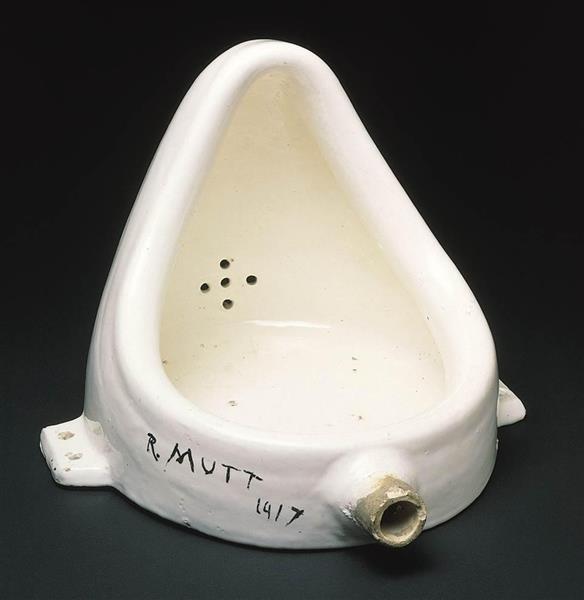
So, contrary to Andre’s quote, it’s ideas all the way down, then. In fact, if one takes a longer view of art history, an argument can be made that Andre didn’t arrive at virgin territory; a connection can be made from the everyday items turned sculptural objets d’art made by Marcel Duchamp, the pioneering modern artist, and, decades later, Andre’s repurposed industrial leavings turned fine art sculptures. Consequently, who’s to say where the idea originated, and, just as importantly, whether or not it matters who did it first because, ultimately, both artists made work that challenged the assumptions of their respective times by letting the work be seen as what it is. What an idea.
Quoth the Greeks: know thyself
There is no set of universal guidelines that can be used to judge abstract art, but this should not be presumed to be a negative. Instead, this lack of external strictures should be seen as providing the space for a dialogue with an artwork as opposed to an interrogation. Abstraction, as an artistic mode, as a way of making ideas visible, is a flexible framework that allows a viewer more leeway in bringing their personal experiences, inclinations, and ways of perceiving to the act of looking at, and responding to a work of art.
Nevertheless, it can be difficult for a viewer to trust that they are already equipped with the necessary knowledge to appreciate a work of abstract art.
The challenge for the viewer becomes the real-time filtering and active looking required to engage with the work in order to find, not the “correct” interpretation, but to arrive at a meaningful personal translation. The idea of an elusive true meaning available only to a select few with some rare interpretative ability or esoteric knowledge is something akin to a MacGuffin: an idea that lacks intrinsic value, and, yet, looms large enough to distract from the essential, and, readily available, process of looking.
While it is an ostensibly simple act, looking at an artwork can, instead, at times, be a process fraught with complexity and ambiguity. Meeting a work where it is would seem to imply accepting it as it is, as well. There is plenty to be gleaned from observation of a work’s outward appearance: among other things, there are its color and surface texture, its form and arrangement in space, its scale. And even those few things can be difficult enough to recognize as worthy of consideration while the viewer is, simultaneously, doubting their own ability to find the “real” meaning of the work.
%20by%20Ad%20Reinhardt%2C%20in%20Arts%20%26%20Architecture%2C%20January%201947%2C%20p.%2022.jpg)
For this reason, perhaps the best way to begin to consider abstract art, given the admittedly wide range of possibilities and not-always obvious path to edification already present in any work of art, is for a viewer to allow themselves the time to observe with intent what is there for them to see, and, also, the space to appreciate that their personal experiences and knowledge are valid and necessary reference points for interpreting the work at which they are looking. In fact, there is more to be lost by rushing this process as not allowing time for reflection could cause a viewer to miss a possible connection with a work that they might have otherwise made.
It is equally important that a viewer not let their response devolve to a binary judgment of “like or don’t like,” but to accept that a work can be challenging to read, might not necessarily accommodate every interpretation, and can, also, still provide a meaningful personal experience by resonating with a personal sensibility or experience that the viewer provides. It is in this alloy that what might be considered meaning is found. A purely intellectual or analytical approach to a work of art is all well and good, and can be rewarding, but, fails to account for the idea that the looking is being done by individuals who should value their individual reactions as a valid response to the work’s presence.
If you didn’t know you knew, now you know you know
Looking at art can be frustrating enough for anyone who believes that they are not already equipped with a base of necessary knowledge of art. Then, on top of that, to be overwhelmed with explanations of artwork that sound more like self-justifying bullshit than any sort of clarification can be enough to make anyone, even those who possess that aforementioned art-knowledge, turn away in exasperation. Oftentimes, these explanations are offered up by artists or critics with the sole intent of making themselves appear slightly more intelligent or fractionally more distinct from others making similar work or working in the same space. The use of art-speak – a jargon-filled approach to talking about art often used by art industry professionals – can perpetuate the misconception that abstract art is a foreign language or a secret handshake that automatically excludes anyone not already “in the know.”
Yet that is exactly what this idea of selectiveness is: a misconception. Abstraction is an open code, available to all, that, yes, obfuscates, but, also, simplifies the act of looking by allowing the viewer to use the personal as a valid reference point for interpreting a work, and, in turn, reaching beyond their lived experiences. It is this relationship, this creation of a bridge between a work and a viewer, that completes an artwork.
As it so happens, Duchamp, an artist considered by many to be integral to the origins of modern art, opined that “…the creative act is not performed by the artist alone; the spectator brings the work in contact with the external world by deciphering and interpreting its inner qualifications and thus adds his contribution to the creative act.”[2] Abstraction serves to facilitate this nexus by opening the ground for the viewer and allowing both the work and the viewer to exist as they are, and to find a mutual understanding. There’s no need for a viewer to look under those plates for hidden ideas because the plates are the ideas, and they’re waiting to be seen.