For the best experience, please rotate your phone or switch to a larger screen.

Horizontal viewing is recommended for full access to this section.

Ruimiao Wang
Interview
< Back
Bio   +
Contact   +
01 Was there a defining moment or specific event that made you seriously think about the meaning of making art?
03When you encounter material limitations or technical challenges, how do you usually respond or adapt?
05For those who have never experienced your work before, what do you most hope they see or feel? and why?
07If you had unlimited time and resources, what project would you most want to realize?What would it mean to you?
09You describe distortion, intense emotion, and the loss of the true self in your writing. However, when looking at your paintings, we also sense something quieter: suspended moments, ordinary scenes, silent witnesses, and a kind of emotional numbness.

Do you see this tension between dramatic inner experience and understated visual expression as central to your work?
02 How do you balance rational thinking and intuitive expression in your creative process?
04Do you mind if viewers interpret your work differently from your original intention? In your opinion, does the artwork belong to the audience once it is completed?
06 Have your personal life experiences, such as geography, culture, family, or education, influenced your practice? Could you share an example?
08Human figures are central to your paintings, but they do not all appear in the same way. Some are built through rough blocks of color, while others are shaped by smoother and more fluid brushstrokes. These different approaches seem to affect how each body carries emotion, identity, silence, or psychological pressure.

How do you decide the visual language for each figure, and is there a personal logic or philosophy behind this method?
10In your paintings, the background is rarely just a background. The surrounding space often feels like an emotional field that presses on, absorbs, or isolates the figure.

How do you use color, emptiness, and spatial composition to shape the psychological atmosphere of the work?
< Back
01
March 13th 2024
2025
Acrylic on canvas
40" x 48"
Was there a defining moment or specific event that made you seriously think about the meaning of making art?
How should I put this? I was a very introverted child growing up. I had little interest in my studies, and I found it difficult to invest significant passion or patience in any single activity.

However, I have loved drawing since childhood; whenever I sat down to draw, I would become completely immersed in the work—losing all track of time. As I gazed at my own drawings, I would begin to meticulously analyze every element: the imagery, the composition, the color palette, and so on.

I realized that I was becoming increasingly absorbed in the creative process. I began to understand that this was the only pursuit in which I could sustain my passion over the long term. Perhaps this is my true calling.
< Back
02
Distance and Proximity
2024
Oil on canvas
36" x 48"
How do you balance rational thinking and intuitive expression in your creative process?
I begin by visualizing in my mind the subject I wish to paint. I enjoy using figures as vessels for inspiration—distorting and exaggerating them to give voice to my own emotions.

I feel the need to channel and release my abstract inner states through a tangible medium within the composition.

I repeatedly refine the design of both the figures and the overall composition, working through countless iterations on my sketchpad. While the inner state conveyed by my art is abstract in nature, I strive to express it through a rational and deliberate approach.
< Back
03
The Artist studio view
When you encounter material limitations or technical challenges, how do you usually respond or adapt?
Initially, I struggled to adapt to the technical challenges I faced. It was, perhaps, the most frustrating experience of my life. I attended PAFA—an institution with a particularly strong and traditional focus on painting. During my senior year of college, I began experimenting with a more expressive approach to painting. Countless intriguing images would flash through my mind, but they were fleeting—gone in an instant, making them incredibly difficult to capture.

I would often pick up my brush and begin to paint on paper, but the process would invariably come to an abrupt halt, simply because the mental image had vanished as quickly as it appeared. I yearned to translate those images from my mind onto the paper, yet whatever I managed to paint always felt incomplete—as if something were missing. I found it nearly impossible to ever feel satisfied with the results.

To break through this creative block, I began carrying a sketchbook with me everywhere I went. I drew every day, attempting to capture those fleeting mental images within its pages. My sketches were filled with scribbled patterns and textual notes—reminders to myself of what the image looked like and how it ought to be rendered.

Yet, I still struggled to translate those abstract ideas into concrete visual forms.
All I could do was keep trying my very best.
< Back
04
Bedroom
2022
Oil on canvas
80 x 60 cm
Do you mind if viewers interpret your work differently from your original intention? In your opinion, does the artwork belong to the audience once it is completed?
It is a very common occurrence for viewers' interpretations to differ from my original intentions.

My oil paintings are deeply personal; they serve as vessels for my emotions. This is particularly true right now, as my artistic style and the specific details of my compositions have not yet fully crystallized.

Throughout this process, I am constantly questioning and challenging myself; I lack confidence, yet I strive diligently every single day. My primary objective—my greatest task—is simply to be satisfied with my own work.
< Back
05
Untitled
2024
Oil on canvas
18" x 24"
For those who have never experienced your work before, what do you most hope they see or feel? and why?
What I most hope my audience understands is that my oil paintings are works created to my own satisfaction. The expression within my art serves as a vehicle for my own emotions.
< Back
06
Butcher Pig
2022
oil on canvas
24"  x 30"
Have your personal life experiences, such as geography, culture, family, or education, influenced your practice? Could you share an example?
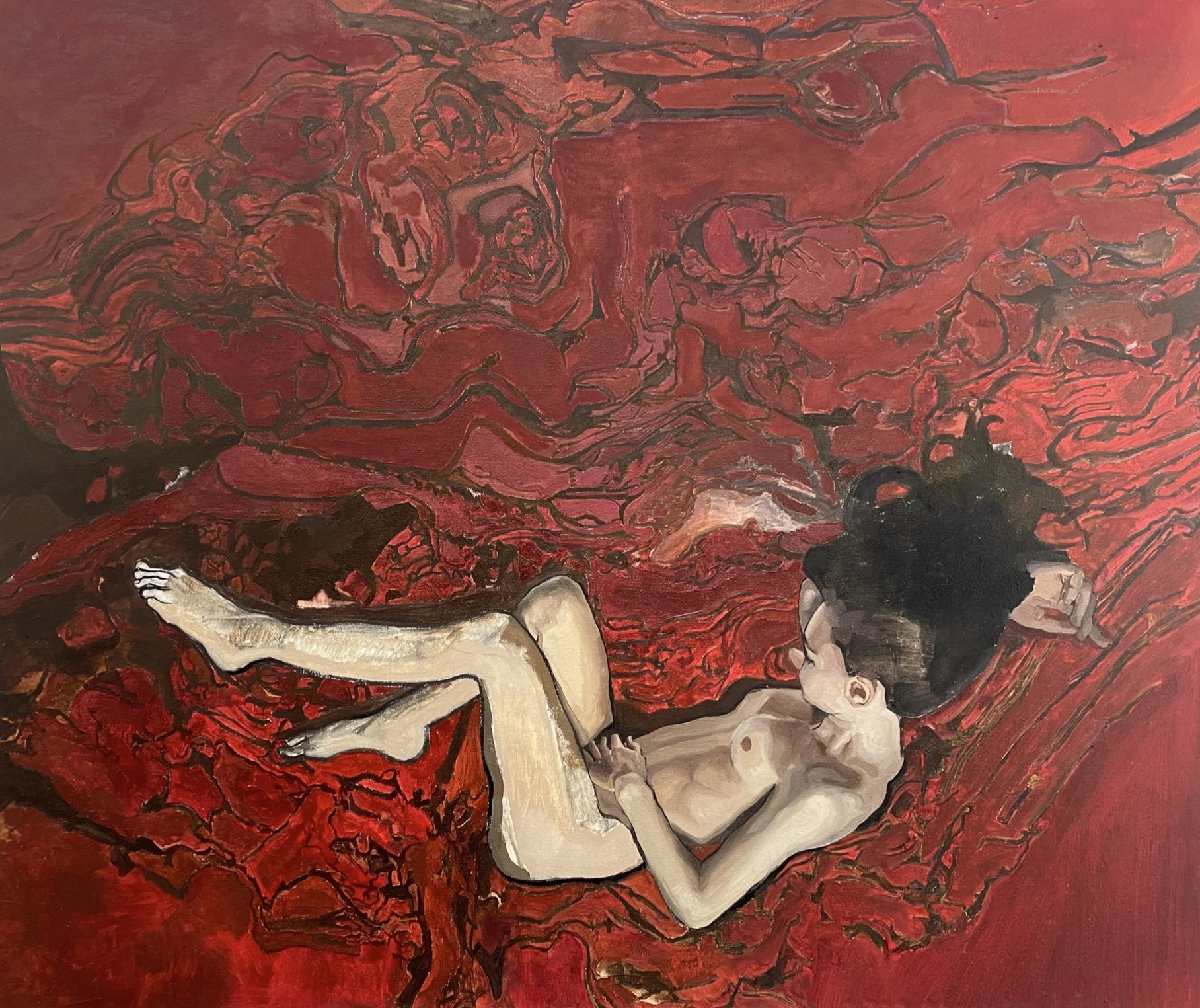
My work, 《March 13th, 2024》, is an oil painting depicting my menstrual cycle. Women—specifically the female nude—have consistently been the central subjects of my paintings. I enjoy portraying the fragile and delicate facets of the female soul.

Menstruation has long been a deeply private subject—one that people often shy away from discussing openly. Through this painting, I aim to use the medium of oil paint to reveal this sensitive and intimate aspect of womanhood.
< Back
07
Artist portrait
If you had unlimited time and resources, what project would you most want to realize? What would it mean to you?
My primary goal is to create an oil painting of a femalefigure that reflects my emotional state. This subjectmatter has consistently been the focus of my artisticpractice. Above all, I hope that when viewers look atmy paintings, they can recognize that they serve as anexpression of my inner emotions.
< Back
08
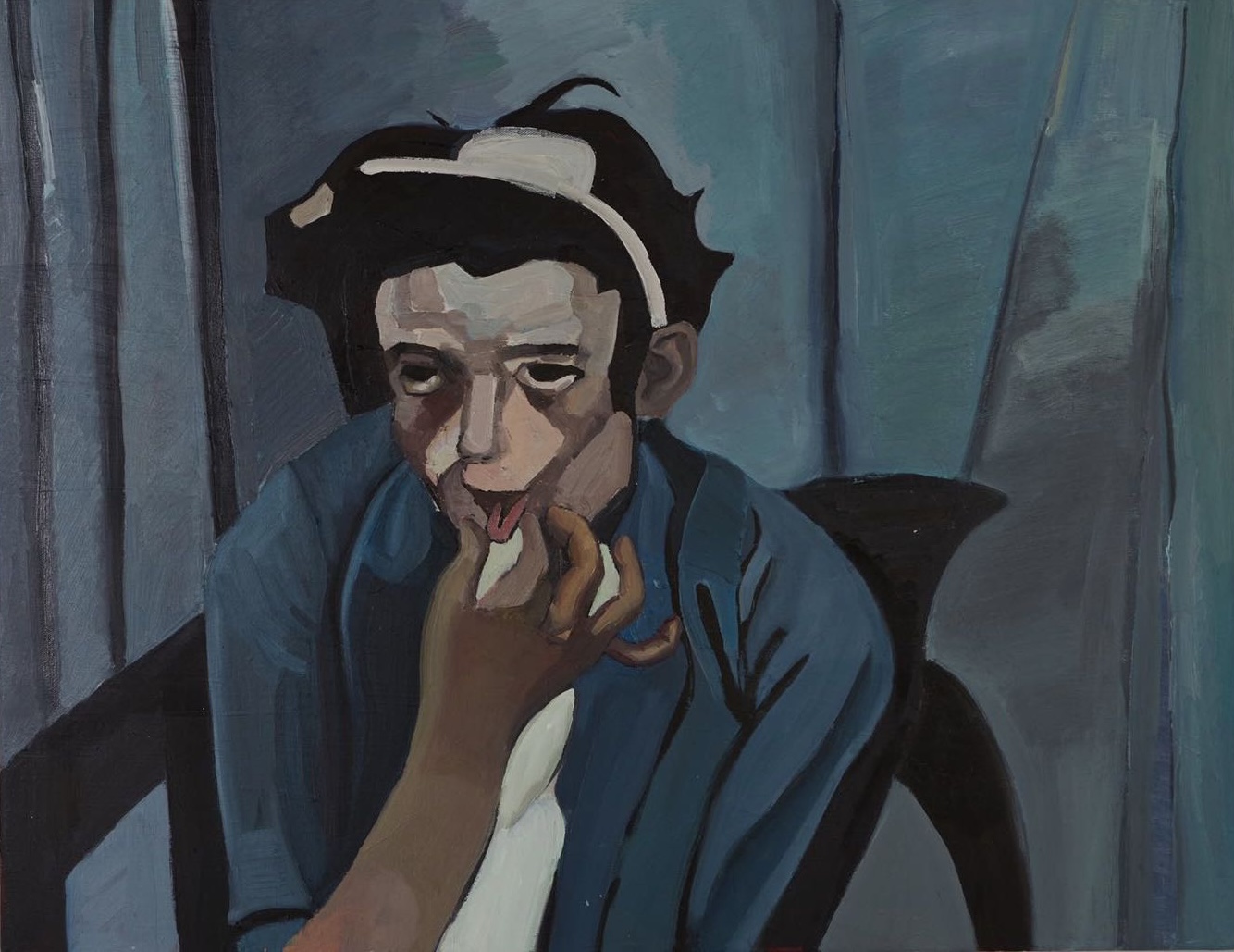
Mental Disorder Patient
2022
oil on canvas
90 × 70 CM
Human figures are central to your paintings, but they do not all appear in the same way. Some are built through rough blocks of color, while others are shaped by smoother and more fluid brushstrokes.

These different approaches seem to affect how each body carries emotion, identity, silence, or psychological pressure.

How do you decide the visual language for each figure, and is there a personal logic or philosophy behind this method?
It simply depends on the specific emotion I wish toconvey. The way a character's posture is twisted—andhow it is paired with the overall color palette—servesentirely to heighten the visual impact of the image.
< Back
09
Process photograph of the artist working
You describe distortion, intense emotion, and the loss of the true self in your writing. However, when looking at your paintings, we also sense something quieter: suspended moments, ordinary scenes, silent witnesses, and a kind of emotional numbness.

Do you see this tension between dramatic inner experience and understated visual expression as central to your work?
I definitely noticed. I think it's because I didn't have agood idea of how to express my emotions more fullyand vividly.
< Back
10
Process photograph of the artist working
In your paintings, the background is rarely just a background. The surrounding space often feels like an emotional field that presses on, absorbs, or isolates the figure. How do you use color, emptiness, and spatial composition to shape the psychological atmosphere of the work?
I certainly will. For me, once the subject matter is established, elements such as composition, color, figures, poses, and the dominant hues of the background can all be utilized to enhance the overall atmosphere of the painting. I want my work to be engaging and distinctive—something that my audience won't simply cast aside out of confusion over what it is trying to convey.
Brooklyn, NY
Menu
Contact us
Newsletter
Thank you! Your submission has been received!
Oops! Something went wrong while submitting the form.
© 2026 Rexhibit. All rights reserved.
Contact us
Newsletter
Thank you! Your submission has been received!
Oops! Something went wrong while submitting the form.
© 2026 Rexhibit. All rights reserved.