For the best experience, please rotate your phone or switch to a larger screen.

Horizontal viewing is recommended for full access to this section.

Rose kimbrough
Interview
< Back
Bio   +
Contact   +
01 Was there a defining moment or specific event that made you seriously think about the meaning of making art?
03When you encounter material limitations or technical challenges, how do you usually respond or adapt?
05For those who have never experienced your work before, what do you most hope they see or feel? and why?
07If you had unlimited time and resources, what project would you most want to realize?What would it mean to you?
09Many of your works are shaped by a visual language of fading, weathering, and decay.Washed-out yellows, stained surfaces, broken architectural fragments, and mottledtextures seem to carry the atmosphere of the rural South.

What draws you to these wornand damaged qualities, and how do they shape your understanding of place, memory,and belonging?
02 How do you balance rational thinking and intuitive expression in your creative process?
04Do you mind if viewers interpret your work differently from your original intention? In your opinion, does the artwork belong to the audience once it is completed?
06 Have your personal life experiences, such as geography, culture, family, or education, influenced your practice? Could you share an example?
08 Your works often feel like fragments of rural homes, roads, fences, churches, andlandscapes pressed into the same surface.

Through torn paper, layered printmaking,repeated plates, monotype color, and hand-painted details, these recognizable placesbecome blurred, broken, and almost geological.

How do you balance the need torepresent a real place with the desire to transform it into memory, atmosphere, orResidue?
10Your work often feels more like a material reconstruction of memory than a directemotional expression of it.

Through paper manipulation, layered printmaking, collage,repeated plates, monotype color, and hand-painted details, places such as abandonedhomes, old Baptist churches, tangled fences, cracked roads, and Alabama soil becometactile and almost archival.

Where does your emotional attachment to these specificplaces enter the process: in the choice of imagery, in the worn and weathered surfaces,or in the act of rebuilding these fragments by hand?
< Back
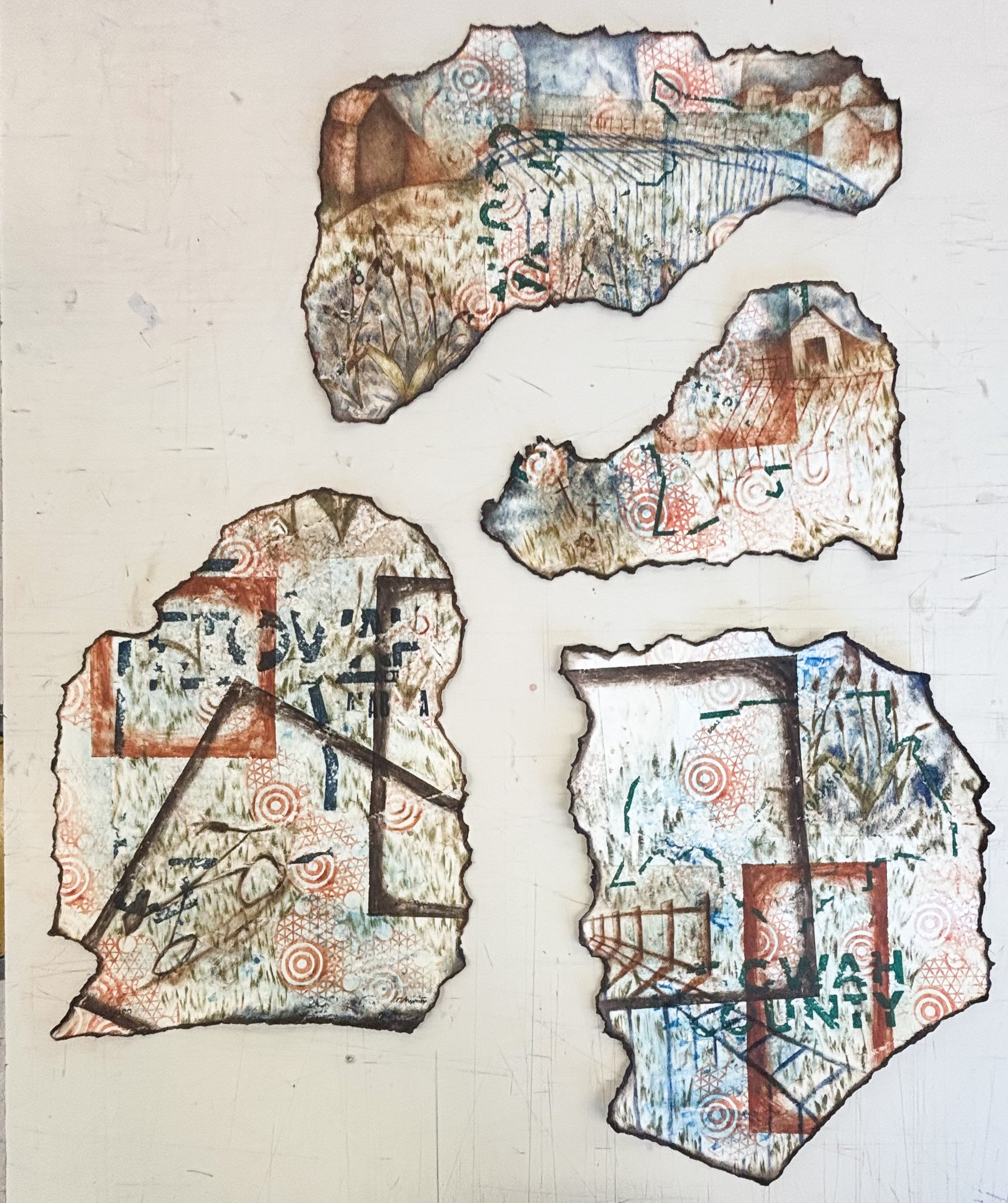
01
An Inconsiderate Artist Attempts to Consider Why; Part I through IV
2025
Etching/Mono-type print
Part I: 16 x 24 in, Part II: 11 x 17 in, Part III & IV: 22 x 18 in
Was there a defining moment or specific event that made you seriously think about the meaning of making art?
The moment I realized art was more than technical skill and object representation was around 7th grade. At the time, I had been rejected from the Alabama School of Fine Arts after the first rounds of review.

When I got my rejection notice, I took the work I had submitted and the portfolio I had prepared to my middle school art teacher in rural Odenville, Alabama. I asked her what was wrong with the work, and at the time, all I considered art to be was perfected technical skill, so I focused on capturing objects and images in perfect semblance. My art teacher had asked me at the time what the work was about, a question I answered by saying I didn't know, I just made it because it looked right. In that moment, she explained to me that how we view an image and how we imagine an image are different, and that perfecting a technical skill can only take you so far. She gave me the advice to write alongside my work. Whenever I had a thought or noticed something that made me imagine something, I wrote it down.

Obviously, there are nuances to this way of thinking that 7th-grade me didn't fully understand, and the work wasn’t groundbreaking or overly conceptual. But it was more honestly a part of me than before, and that experience showed me that if I didn’t take my work seriously, then the opportunities I dreamed of would always be out of reach.
< Back
02
Pine Flat Alabama
2024
Etching/Mono-type print
20 x 27 in
How do you balance rational thinking and intuitive expression in your creative process?
I think as an artist, rational thinking just blends into intuitive expression. When I create work, I dont think of principles of art, like line, shape, variation, color, or composition. An image comes to me based on an emotion or memory, and I just allow it to happen. What is rational to me is always intuitive when creating work.
< Back
03
Oh, Really?
2025
Etching/Mono-type print
26 x 35 in
When you encounter material limitations or technical challenges, how do you usually respond or adapt?
I often have pieces in my head that I want to copy and paste into reality. But the truth is that those ideas can be influenced by things unattainable to me at the time. Like when I see artists with unlimited material, space, and technical skill, I often find myself wishing for that. I have to remind myself that my work is meant to meet me where I am, not be something it can’t be.

So when I find myself longing for more permanent studio space, or more materials, or better skills, I remind myself that everything I need is provided. A studio can be anywhere, a friend's kitchen or living room, a park or backyard, and materials can be anything, and can be obtained anywhere.

I am blessed enough to be surrounded by artists, professors, friends, and family who are more than willing to allow me to barter or borrow their materials, or use their equipment or space. Who are willing to teach and show me anything I may need to know to make an idea a reality. In the end, the art will happen, no matter the limitation or challenge.
< Back
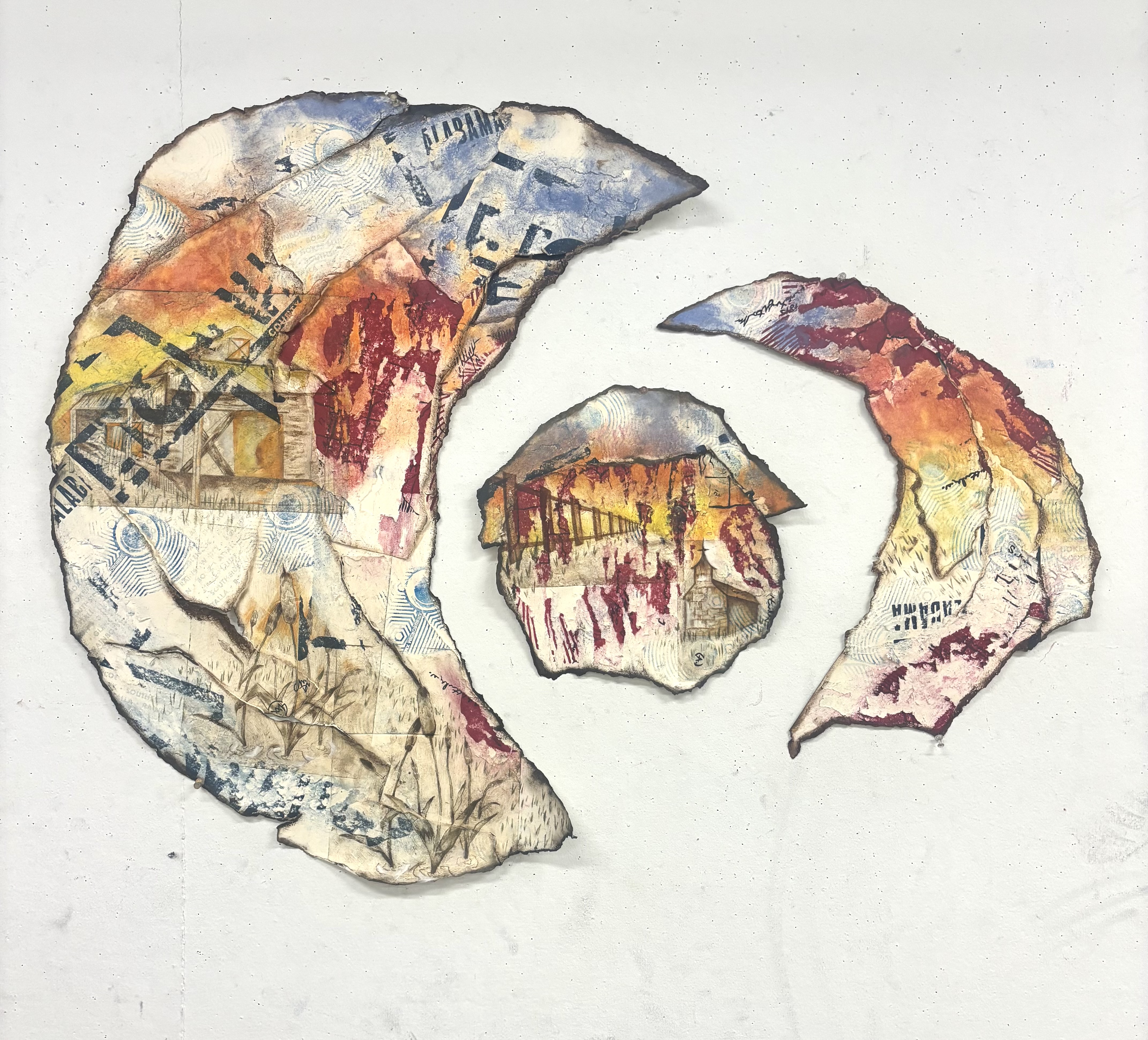
04
Rolling Fields & Hollering Winds
2026
Etching, Screenprint & Monotype
35 x 37 in
Do you mind if viewers interpret your work differently from your original intention? In your opinion, does the artwork belong to the audience once it is completed?
I don’t mind at all. The work I make will always be a part of me; no work I make is without care or meaning. Each piece is a piece of me. Once it’s completed, it doesn't lose its meaning or connection to me. The whole reason I make the work is to connect with the viewer, in hopes we can understand and see each other. I intend the viewer to interpret whatever it is they see within the piece.

Maybe a woven landscape doused in red and yellow is a representation of my suffocation, and to my viewer, it makes them feel retrospective, or makes them remember a moment in their life where they have felt intense emotion.

Obviously, as an artist, I use tools like color, atmosphere and perspective with visual language to guide my viewer into a feeling when they view my work. But my intent isn't to control them. The work is made with a part of me, for a part of my viewer, so we can understand each other. So maybe the audience and I have amicable joint custody over the artwork.
< Back
05
The SUNBELT: Interceptive Relation
2025
Etching, Screenprint & Monotype
2ft x 30 in
For those who have never experienced your work before, what do you most hope they see or feel? and why?
I hope when you view my work for the first time, you feel as though a part of you is seen by me. That things are never truly forgotten or abandoned, and that the work is here to remind you of what you may have forgotten.
< Back
06
Where You Step
2026
Etching/Monotype
6ft x 30 in
Have your personal life experiences, such as geography, culture, family, or education, influenced your practice? Could you share an example?
Yes, all my work is influenced by my family, location, culture, and education. I was born and raised in Alabama, and moved between Trussville, Odenville, Springville, and Alabaster, all within a 50-mile radius of central Birmingham.

Birmingham is largely populated and has busy roads, tall office buildings, and hosts large-scale public events. Trussville, Springville, and Alabaster are all family-centric cities. They have nice school systems with extensive sports programs, as well as small family-owned shops and boutiques.

But they aren't all that similar. Springville’s neighborhood is anchored by a central church and a walkable town center. Alabaster and Trussville couldn't ever be walkable, even if the cities tried, with Alabaster being much more open-spaced and Trussville a little overdeveloped. Odenville is on the rural spectrum of these four locations.

Each city has its own culture, atmosphere, and expectations attached to it, all of which have affected my art and informed the way I create images and layering.

Educationally, my art practice and mentality wouldn’t exist if it weren't for the Alabama School of Fine Arts Visual Arts Department. It's the school I attended from 8th to 12th grade, and where I learned to have ambitions, how to express myself, and how to be honest with myself and others.

It’s where I was taught that my work and voice mattered. The experience I had in the Visual Arts Department, surrounded by my class of 10 and my overly patient instructors, is what made me into the artist and person I am today.

I feel as though I still rely on all of them now, and often look back on the advice they have given me. For their care, time, and confidence in me, I will always be grateful.
< Back
07
Artist Portrait
If you had unlimited time and resources, what project would you most want to realize? What would it mean to you?
I actually don’t know. I have sketchbooks filled with ideas and experiments I have never tried, so maybe I’d take as much time as I’d like to try every idea. That opportunity to freely experiment without worry would allow my work to be better informed of all possibilities.
< Back
08
Pine Flat Alabama
2024
Etching/Mono-type print
20 x 27 in
Your work draws heavily from Taiwanese temple culture, Buddhist ritual, and materials such as incense ash. But these works are being made within the context of New York, farm from the original sites of those rituals.

How does this distance affect the meaning of these materials for you?

Do they remain connected to religious practice, or do they become a way to negotiate memory, migration, and identity?
In my mind, every real place is just a memory. Every street I walk, every building I enter, and any land I see, I always imagine what was and how it came to be.

There are layers to every reality and real-world tangible thing that holds human connection. The home I lived in as a child is still a real place, but the memories of that place are just layers, covered up by the new family that now builds memories on top of mine.

Their life leaves imprints: crayons on painted-over walls, the flaking paint in the living room, the leftover smell of hand-rolled cigarettes, covered now by some other family's laundry detergent and vanilla-scented candles.

When I create a piece, it's because I have encountered a place that connects to these memories, and it makes me think of who has been and is within that place.

If we have the capacity of remembering, then the land and structures built upon it surely have to remember us as well. So I like to take the real place and merge it with the residue of what was or could have been.
< Back
09
Oh, Really?
2025
Etching/Mono-type print
26 x 35 in
Your work often feels spiritual, but not necessarily religious in a strict sense.

The smoke-like forms, ash surfaces, and energetic gestures seem to materialize attention, intention, and emotional transformation rather than illustrate a specific belief system.

How do you understand the difference between religion, spirituality, and meditative awareness in your practice?
I think that deep down, all my work is founded on a fear or acknowledgement of abandonment. It’s a very human fear that we can all connect with.

When I see homes decaying and weathered, fragments of impressions in lawns of tire marks, or the stripped color of a car due to the harsh sun, it makes me think of how those objects came to be that way.

A home built to once shelter and protect a family or person, made of memories and purpose, but now forgotten and abandoned either from lack of care or due to its qualities. A lawn destroyed and overgrown because it’s no longer a place for kids to play, or for others to admire, and a car sun-washed because at some point someone forgot or was unable to drive it.

Life is fast-paced, and we often can’t find time to care for the things around us. I just have a deep connection to those things. In some way, I fear that I’ll forget to care, that care will become overwhelming, or that others will become overwhelmed by having to care for me.

In some capacity, we can all connect to that fear or knowledge of abandonment, and I choose this visual language because it’s the signs of abandonment that we encounter every day, no matter our location.
< Back
10
Rolling Fields & Hollering Winds
2026
Etching, Screenprint & Monotype
 35 x 37 in
Your practice is influenced by Buddhist ideas such as impermanence, cyclical
becoming, and non-attachment, yet you work with materials that hold traces of what has already passed: incense ash, soil, pigment, residue, and layered surfaces.

When you collect and transform these remains into physical works, do you see the process as a
way of letting go, or as a way of preserving what would otherwise disappear?
Brooklyn, NY
Menu
Contact us
Newsletter
Thank you! Your submission has been received!
Oops! Something went wrong while submitting the form.
© 2026 Rexhibit. All rights reserved.
Contact us
Newsletter
Thank you! Your submission has been received!
Oops! Something went wrong while submitting the form.
© 2026 Rexhibit. All rights reserved.