For the best experience, please rotate your phone or switch to a larger screen.

Horizontal viewing is recommended for full access to this section.

Diana Chicaiza
Interview
< Back
Bio   +
Contact   +
01 Was there a defining moment or specific event that made you seriously think about the meaning of making art?
03When you encounter material limitations or technical challenges, how do you usually respond or adapt?
05For those who have never experienced your work before, what do you most hope they see or feel? and why?
07If you had unlimited time and resources, what project would you most want to realize?What would it mean to you?
09Your work often uses polished and seductive imagery to address ecological instability and material excess. What role does visual attraction play in opening conversations about serious environmental issues? How do you hope it makes these complex subjects more approachable to viewers?
02 How do you balance rational thinking and intuitive expression in your creative process?
04Do you mind if viewers interpret your work differently from your original intention? In your opinion, does the artwork belong to the audience once it is completed?
06 Have your personal life experiences, such as geography, culture, family, or education, influenced your practice? Could you share an example?
08Across your practice, a distinctive reddish-brown tone often appears alongside white organic forms and technological details such as circuits, wires, and solder points. In works such as Nature’s Tissue, these elements connect bodily tissue, geological terrain, and engineered systems.

Do they operate as parts of a single visual system? How does their convergence shape your understanding of the boundary between the artificial and the organic?
10Across your sculptures, moving-image works, and two-dimensional pieces, geological and muscle-like forms are often divided by vector-like cuts and geometric edges.

How does this recurring contrast between organic forms and precise segmentation contribute to the layered juxtapositions and polarities in your work? Why is this visual complexity important to your understanding of reality?
< Back
01
The Klimate - Nature's tissue 1
2026
Ink on metal plate
20 x 30 in
Was there a defining moment or specific event that made you seriously think about the meaning of making art?
I started making artwork for fun. At that point, I did not call it art, but my work began to gain traction online. I dreamed of finding a way to work at the intersection of creativity, technology, and environmental or social issues, especially climate change, so it felt like a dream. I realized very quickly that this would be a long path full of work and no guarantees for the rest of my life. I accept this path, whatever it brings.
< Back
02
The Klimate - Nature's tissue 2
2026
Ink on metal plate
20 x 30 in
How do you balance rational thinking and intuitive expression in your creative process?
The rational side happens when I read, listen, watch, or write. Those inputs simmer in my mind, and later I know how to process them visually. It begins as a soft whisper in the wind that combines what I have actively studied with mysterious elements of the universal consciousness that come to anyone willing to listen.
< Back
03
The Klimate - Nature's tissue 3
2026
Ink on metal plate
20 x 30 in
When you encounter material limitations or technical challenges, how do you usually respond or adapt?
I don’t like to follow instructions. What I normally do is experiment fully. From the mistakes I make, some questions come up that I can take to an expert friend, online or offline. People are very kind when you ask them for help in their area of knowledge. Or I just Google it.
< Back
04
The Klimate - Stone flesh
2026
Ink on Alabaster Stone
8 x 7 in
Do you mind if viewers interpret your work differently from your original intention? In your opinion, does the artwork belong to the audience once it is completed?
The artwork belongs to the universal consciousness, expressing its different faces through human perspectives, or perhaps through whatever else might be observing from beyond our world. Because of this, it is exciting to hear varied interpretations, even when they are critical or negative. My work does not belong strictly to me or my individual intellect, but rather to the vast web of consciousness surrounding us all, so I do not take differing interpretations personally.
< Back
05
The Klimate_Stone Tissue
Exhibition View
For those who have never experienced your work before, what do you most hope they see or feel? and why?
I want them to consider the possibilities of technology and nature existing together in the next era of humanity. It is crucial that we discuss this trajectory. My goal is to use digital and physical creative tools to foster harmony between humans and ecosystems, encouraging people to value, understand, and love those ecosystems to the core.
< Back
06
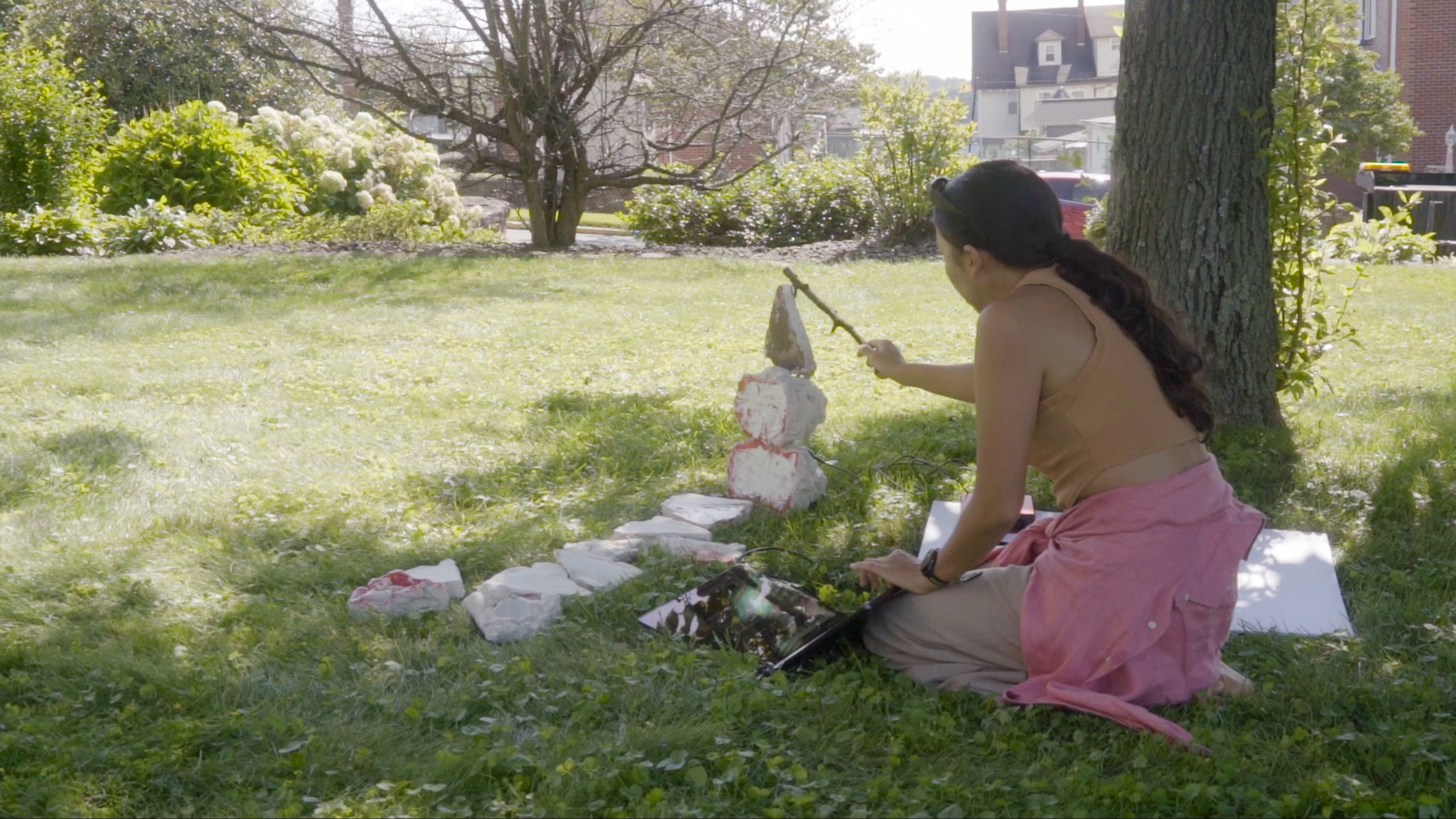
Studio Portrait 1
Have your personal life experiences, such as geography, culture, family, or education, influenced your practice? Could you share an example?
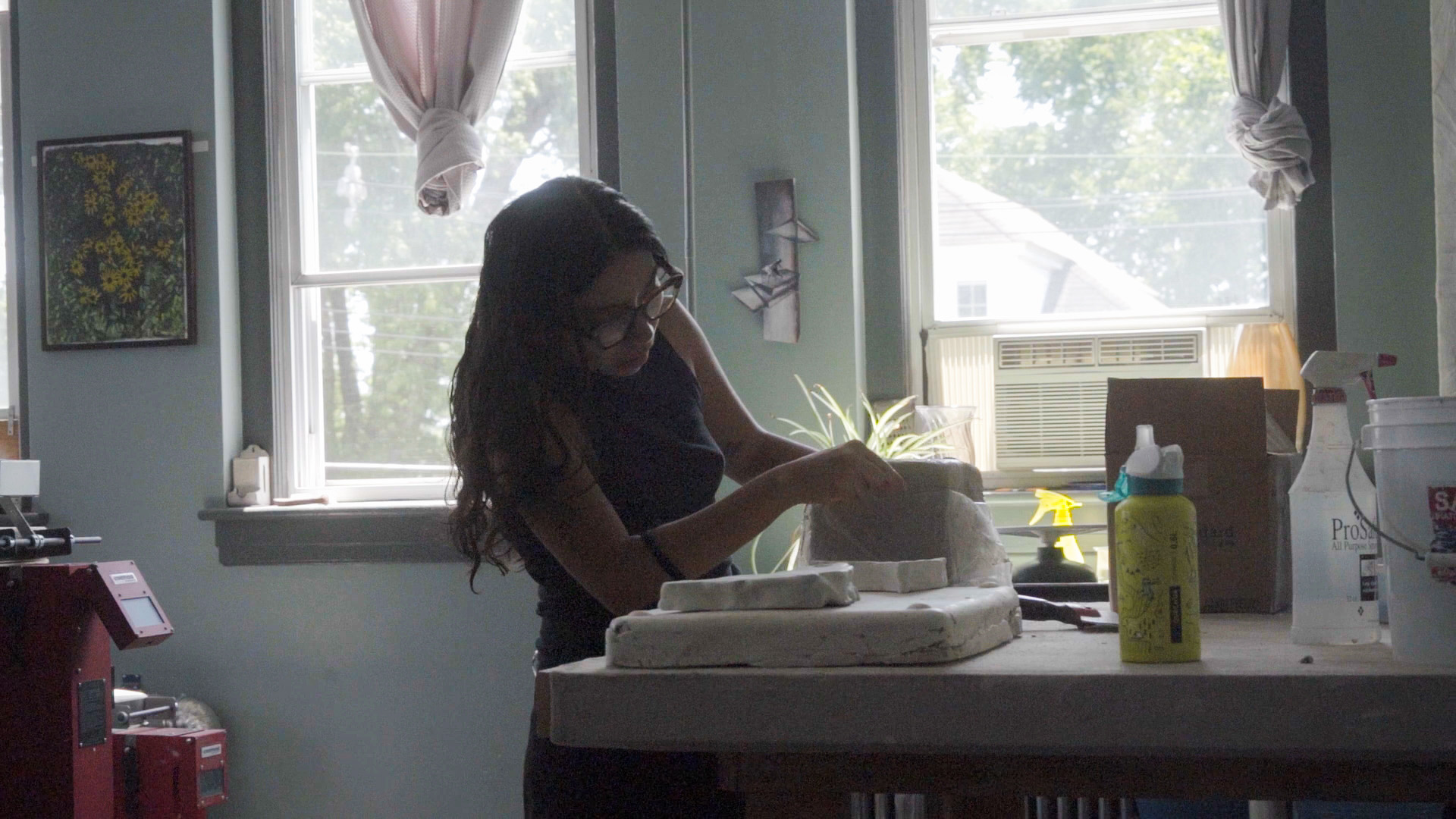
Absolutely. Being an LGBT immigrant woman from Colombia living in New York has had a huge impact on how I understand the world around me. I believe the material conditions of every human being determine many of their future possibilities. I was born in a very unequal country full of beautiful, diverse nature. It is also a very happy country that provided the best education I could have asked for, full of critical thinking and research. My life has been full of contrasts and changes, which have directly influenced my impulse to combine raw organic forms with digital systems.
< Back
07
Studio Portrait 2
If you had unlimited time and resources, what project would you most want to realize? What would it mean to you?
I would definitely go to Antarctica to conduct deep research alongside a team of scientists and artists for several months. I would create digital or sculptural artwork, or maybe an installation, addressing the state of whales and marine life in the region, then exhibit the resulting work wherever I could.
< Back
08
Archaic Iceberg
2026
Digital Video
4K / Variable
Watch Full Video
Across your practice, a distinctive reddish-brown tone often appears alongside white organic forms and technological details such as circuits, wires, and solder points. In works such as Nature’s Tissue, these elements connect bodily tissue, geological terrain, and engineered systems.

Do they operate as parts of a single visual system?

How does their convergence shape your understanding of the boundary between the artificial and the organic?
They operate as parts of a connected system. While some might call this transhumanism, my intention is different. I do not want humans to have circuits in their flesh. Instead, I want to show that technology comes from the same source as we do. The line between the artificial and the organic is mostly a matter of language and timing. If time is circular, technological advancements share an origin with us, making them part of the same biological and aboriginal lineage.
< Back
09
Sunset Iceberg
2026
Digital Video
4K / Variable
Watch Full Video
Your work often uses polished and seductive imagery to address ecological instability and material excess.
What role does visual attraction play in opening conversations about serious environmental issues?

How do you hope it makes these complex subjects more approachable to viewers?
Humans are naturally drawn to beauty, so I view visual attraction as an effective tool for opening conversations about serious environmental issues. A compelling visual entry point can make complex topics more approachable rather than overwhelming.
< Back
10
Nature's tissue
2026
Digital Video
4K / Variable
Watch Full Video
Across your sculptures, moving-image works, and two-dimensional pieces, geological and muscle-like forms are often divided by vector-like cuts and geometric edges.

How does this recurring contrast between organic forms and precise segmentation contribute to the layered juxtapositions and polarities in your work?

Why is this visual complexity important to your understanding of reality?
The feeling created by layered juxtapositions is very important in my work. It helps to reveal the complexity of the different polarities and layers we are born into. This realm of reality is so complex, beyond anyone’s understanding, but I believe we should strive to attain more knowledge, creative inputs, and points of view, becoming more complex beings on this plane. As you can see, I’m an artist full of existentialism with a large dash of pragmatism. I think humanity could be more than okay in the upcoming era.
Brooklyn, NY
Menu
Contact us
Newsletter
Thank you! Your submission has been received!
Oops! Something went wrong while submitting the form.
© 2026 Rexhibit. All rights reserved.
Contact us
Newsletter
Thank you! Your submission has been received!
Oops! Something went wrong while submitting the form.
© 2026 Rexhibit. All rights reserved.